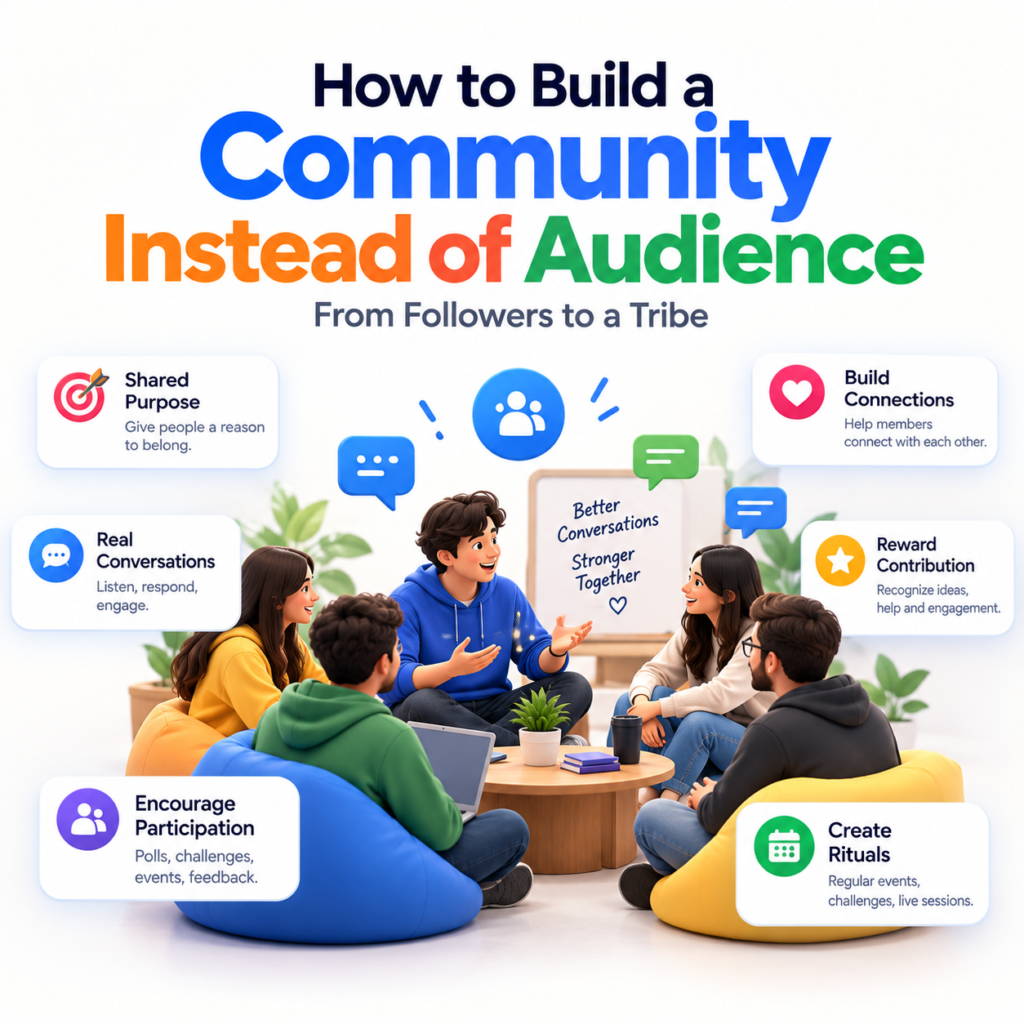
Creating a community entails creating a long-lasting web of connections centred around a common goal. build a community instead of audience Developing an engaging community requires a well-thought-out plan, the right tools, and consistent community animation, whether it is done online or offline. The profession of creating a community is known as the “community builder.” It is their responsibility to create and manage a community. Definition: what is a Community Builder? An ambassador for their local Couchers.org group is a group Builder. build a community instead of audience.They collaborate with others to promote and enhance the Couchers.org platform; they assist, organise, and expand their community; and they act as role models within the Couchers.org community. In addition to interacting with the neighbourhood, build a community instead of audience.Community Builders collaborate and communicate with volunteers and other Community Builders. In this manner, the platform may develop and improve in response to community input, and the community and organization can collaborate to uphold our values and accomplish our objectives. Audience vs. Community: What’s the Real Difference? The audience and the community are so similar that they appear to be the same thing. This is actually not at all true.build a community instead of audience The definitions of audience and community, their distinctions, and the potential long-term benefits of creating a community will all be covered in this article. Direction is the fundamental difference. You are facing an audience. Instead of being the only broadcaster, you are the facilitator in a community that faces one another.build a community instead of audience Because communities don’t simply consume, they also contribute, defend, and naturally expand the brand, this is the reason why so many firms now opt to create a community rather than an audience. Why You Should Build a Community Instead of an Audience 1. Communities Are More ResilientAlgorithms on social media platforms are always changing. If reach declines, an audience developed solely on one platform may disappear quickly. A community is not dependent on a feed, particularly if it is hosted on owned channels like a newsletter, forum, or Discord. 2. Higher Engagement, Lower Cost Members of the community converse, respond to enquiries, and produce material on your behalf. This lessens the pressure on you to consistently create fresh content in order to remain prominent 3. Stronger Trust and Loyalty Compared to brands, peers are more trusted. Members gain credibility more quickly than any advertising campaign when they see other people endorsing your goods or concepts.build a community instead of audience How to Build a Community Instead of an Audience: Step-by-Step Step 1: Define a Shared Identity, Not Just a Niche A topic is described by a niche.build a community instead of audience. A person’s identity characterises the person they become after joining. What do members call themselves, you ask? What do they hold dear? Instead than focusing only on topic content, strong communities frequently develop around identity (“we’re the people who…”). Step 2: Choose the Right Platform Choose a platform based on where your ideal members are already at ease rather than just what’s popular.build a community instead of audience Step 3: Design for Interaction, Not Broadcasting You’ve created a newsletter with additional steps if you are the author of every post in your space. Rather: Step 4: Give Members Roles and Responsibility People stay engaged when they feel ownership. Consider: Step 5: Prioritize Depth Over Size Chasing the number of members is a common error. A group of 20,000 lurkers will never perform as well as a community of 200 highly active individuals. Pay attention to: Step 6: Measure the Right Metrics Stop obsessing over follower counts. Track instead: Common Mistakes to Avoid Real-World Examples What the brands and creators that managed to choose a community over an audience have in common can be described as follows: regularity of their activity, values, and readiness to give the initiative to the members. build a community instead of audience.It doesn’t matter whether it is an enthusiast’s community, a professional one, or a consumer community — the same applies to them all. Conclusion:building and maintaining a community Building a community is a human and group endeavour founded on a common vision of the community, not just a set of tools or activities. a clear vision, a solid mission, and a dedication.build a community instead of audience Every step discussed in this article—from setting goals to foreseeing change—is a crucial component in creating a team that is enduring, practical, and motivating. Communities are emerging as significant sources of connections, loyalty, and value creation at a time when businesses and organisations can no longer be content with just audiences. If you take the time to establish the groundwork, build a community instead of audience.include your members right away, listen to them, and cherish them, you’ll witness the development of something much more than a group—a genuinely devoted ecosystem with a multitude of connections!
Welcome to WordPress. This is your first post. Edit or delete it, then start writing!